Anti-casualisation starts at home:
Why it matters that our unions treat their staff as we fight to be treated at work.
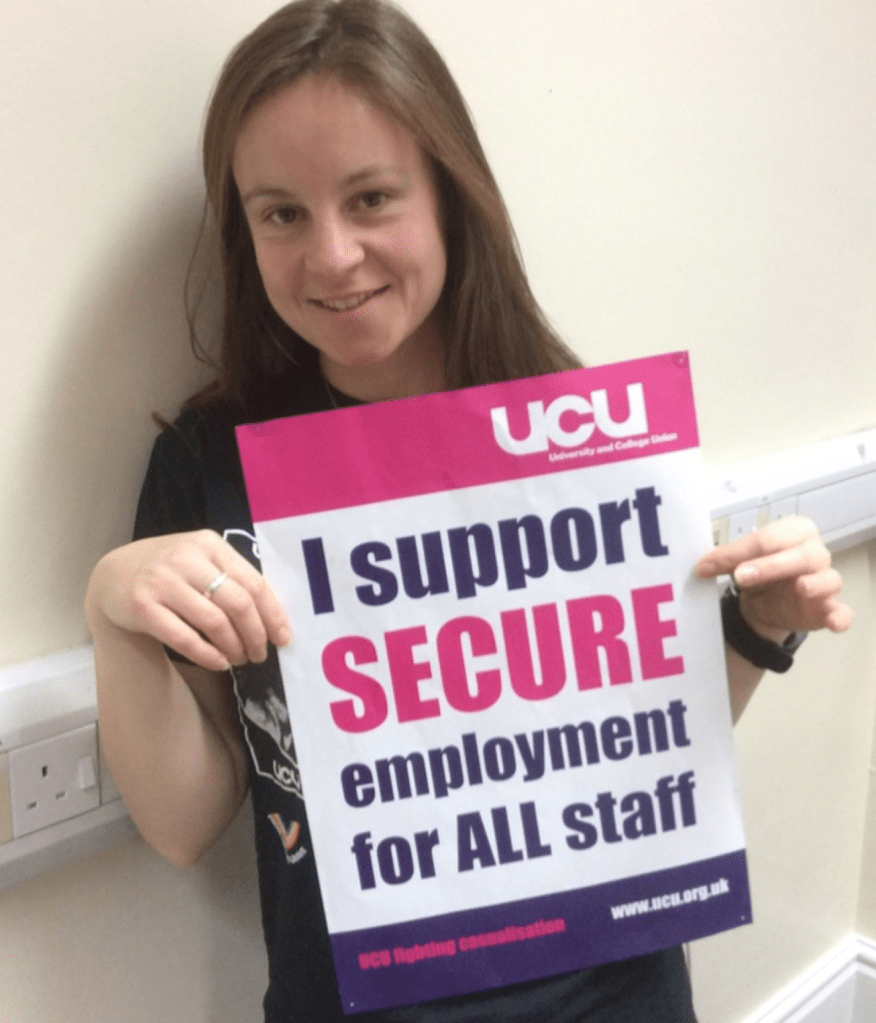
If we want a better future, we must imagine it together. For a trade union, this is central to winning better conditions in the workplace, and building decent communities. Recent events in UCU have caused me to reflect again on the barriers that casualisation creates and exacerbates in the workplace and in our union, especially for postgraduate researchers, who are still sometimes denied even the formal status of “worker” by employers for their labour. Casualisation makes everything else worse, and undermines permanent posts and working conditions. This post looks at UCU’s PGRs as Staff campaign and how union resources can be used to take action on “the greatest organisation question facing us as a union”.
I joined UCU in 2009. I was a PGR at Durham University campaigning within my department against opaque work allocation and underpayment and non-payment of wages. We had not joined UCU because we did not know we could. One rainy day, I met a woman with a clipboard collecting signatures to campaign for decent conditions for postgrads. Jean told me that UCU did represent us and that UCU activists wanted to campaign against casualisation and for proper working conditions for us. She changed my life by encouraging me to join the union to join the fight against casualisation, including by changing our union’s structures to better represent us and by shifting our bargaining agenda. I joined the UCU Anti-Casualisation Committee in 2011, and became its chair in 2012. In 2013, I was elected to the National Executive Committee to represent staff on casual contracts.
That anti-casualisation work should be key to successful union organising and be adequately resourced should be an obvious truth given the widespread use of precarious contracts across post-16 education. It is now key to UCU’s policy and bargaining agenda. But in June 2014, at the inaugural UCU Anti-Casualisation Training and Organising conference it felt significant that a senior member of UCU staff reflected to attendees that “the greatest organisation question facing us as a union is how we organise casualised staff”. That recognition was significant because the UCU Anti-Casualisation Committee had just won a number of battles to secure our ongoing existence as a representative committee,1 for our union to better resource the work we wanted to drive forward, including that very conference, and for robust data collection to underpin our bargaining objectives. We worked hard to develop our online presence and to organise networks of members on casualised contracts, challenging many assumptions being made about us, not only by our employers but also within our own union structures that we set about overhauling. We organised from the grassroots to establish and build robust and practical policy commitments that would transform our union through practical organising. (See here for more background).
In September 2020, Higher Education Sector Conference (HESC) delegates voted to launch the PGRs as Staff campaign. It launched formally via an exploratory workshop in November 2020 [video here], and in Autumn 2021 UCU employed two PGR members to job-share a new campaign lead role. They have worked with members and potential members to build organising power and confidence, to drive lobbying efforts with employers and research funders, and ensure that this bargaining and campaigning work was rooted in the lived experiences of those on the sharpest end of poor employment practices. When their report and recommendations were brought to the Higher Education Sector Conference at Congress 2023, I was delighted not to be able to speak because so many other delegates had got up to speak in favour of continuing and expanding this work. Most of the speakers were PGRs who have become heavily involved in local and national campaigning. The report, which is well worth reading in full, was adopted overwhelmingly. Every speaker spoke enthusiastically of the support they had received from their union via the project and of the support they were now equipped to offer others.
On 9 June, we learned that the campaign leads were to be dismissed. Their union, Unite, is in dispute with UCU as an employer to oppose the redundancies. At the time of writing, a majority of UCU staff have indicated that they are prepared to strike to defend their jobs.
Our anti-casualisation organisers were employed on casual contracts so short that the normal protections against unfair dismissal do not apply. As a matter of policy,2 UCU demands 24 month contracts for our members for exactly this reason: at 24 months, employers are obliged to properly justify a dismissal. In our own branches, we work every day for this basic standard. When these short contracts were issued to our own union’s staff, I wrote to the General Secretary to express my concerns and querying whether there was an error in the advertisement. The Anti-Casualisation Committee and members of the NEC did the same. Some of us believed that these contracts would be renewed later. They were not.
We should treat our own staff as we expect our members to be treated. We must treat casualisation as central to our work for decent conditions. UCU Congress and Sector Conferences have repeatedly committed our union to campaigning to end casualisation. We are now in the position of disrupting some of our most successful organising work on the issue, by sacking the organisers who have supported members doing this work.
We should be able to expect our union to model the employment practices we want to see from employers. The PGRs as Staff campaign is vital work which must be understood as part of UCU’s anti-casualisation campaigning bedrock; it does not make sense to conceive of this as a temporary or limited workstream for our organisation, and particularly not when HE Sector Conference has committed to continue and expand it to support further areas of de-casualisation work.
The PGRs as Staff report unflinchingly describes the barriers postgraduates face in the workplace and in the union, and tells the story of the organising work and the progress it has made. A key recommendation approved by the Sector Conference is that the organising model be extended to other casualised workers in education, building the confidence and organisation of other marginalised members.
Key to successful campaigning, especially amongst casualised workers, is continuity of organisation. Local campaigns against casualisation regularly have to start from scratch every year as activists move on when their contracts are not renewed. Vulnerability to dismissal often makes members reluctant to organise openly. We find ourselves repeatedly having to examine and challenge internalised narratives from our employers about how interchangeable they might like us to feel. At the 2020 launch of the PGRs as Staff campaign, I noted how many people explained that they felt unable to use their real names in the online chat. For the same reason, it can be difficult for members to use their real names in media articles. By dedicating organisers to anti-casualisation work, we built our own union’s institutional memory and protected branch activists from employer retribution.
Beyond the clear benefits of this work for our PGR members, a large-scale campaign like PGRs as Staff, which mobilises a substantial group of members, has knock-on effects for other groups within our membership. In many cases, when we negotiate a clearly defined improvement in benefits for one group of casualised staff, it can crack open the door for other groups of staff to fight for the same benefits. The fight for PGRs to be recognised as staff on proper contracts which recognise the value of all their labour reinforces the fight for the same respect for others who are employed on hourly paid contracts, often for years, such as Academic Related and Professional Services (ARPS) staff in student support. Successfully advocating with external funding bodies for better benefits and pay rates for postgraduates as the PGRs as Staff campaign has done, has clear ramifications for raising the baseline for post-doctoral researchers funded by external bodies. Opportunities to progress this work have already opened as a result of the current project3. Fighting for PGRs to receive the same incremental pay increases as other staff on the pay spine will support other categories of staff employed on fixed-term contracts fighting for these rights.
I joined UCU because Jean convinced me that (despite some appearances at the time) my branch cared about me, and would fight for me, that the union was for every worker, and postgraduates were workers too. In the branch I found people who had been through similar experiences to me, and who knew that casual contracts are not a “rite of passage”. They made and held space for us to unlearn the gaslighting of our employers together, learn that we deserved better, and begin to work for it. That lesson is now UK-wide union policy.
We, and our students, deserve better. As a union we need to resist casualisation in the workplaces we organise, and in our own employment practices. The news on 10 July that UCU would replace the two PGRs as Staff campaign leads with a “smaller as yet undefined role” undermines the members working to resist casualisation in our branches, and does not reflect our values when it comes to employment. Casualisation is the biggest threat to decent conditions in post-16 education. It makes workers vulnerable and afraid to resist. Ending it requires long-term action with stable employment for the organisers, so that they can plan the work that needs to be done, and so that branches know they can call on the support of specialist union staff. Given the two posts in question combine to 1.0 FTE and actively support us in growing our membership (and subscriptions), it should be possible to build this stability into our long-term planning.
Talks between UCU and Unite have begun at ACAS. In the meantime, here are some things you can do.
- There are two letters in circulation available for members to sign in connection with this issue:
- A letter addressed to the UCU Trustees, which I have coordinated with a number of concerned NEC reps and branch officers, to raise concerns about the redundancies as a threat to the union’s organisational capacity, reputation, and long-term finances. This is open for members to sign but we ask that the link is not directly shared on social media to best allow the Trustees to address concerns raised. If you would like to read and potentially sign this letter, please use [this contact form].
- A PGR-led open letter to the General Secretary calling upon her to reverse the decision to issue redundancy notices and/or reduce the overall staffing resource for this work to the two PGRs as Staff campaign leads. You can read that [here] and it is still open for signatures should you wish to add your own. It is also possible to submit personal testimony via this form. Branch motions in support of reversing the redundancy notices appear in an appendix to the letter.
- Read and share the excellent [PGRs as Staff report] that went to HESC at Congress 2023, and advocate for your branch to take up the approaches advocated within it.
- Raise the issue of casualisation and activist-led organising in your branch and region; advocate for registering as many casualised members as possible at the UCU Annual Meeting for Staff On Casualised Contracts.
Notes:
1. The Anti-Casualisation Committee (ACC) represents all casually employed staff and fights the exploitation of casual contracts throughout FE, HE, ACE and prisons. It is comprised of reps elected at the Annual Meeting (to which all casualised members can register to attend) and two NEC representatives elected at the UK level to represent members on casualised contracts in FE and HE. See https://www.ucu.org.uk/fthpcommittee and http://www.twitter.com/ucuanti_cas
2. This policy was agreed at our Higher Education Sector Conference at Congress 2019 (motion 14 [link]), and reaffirmed as a fundamental bargaining principle for all UCU members in Congress motion 21, in 2021 [link].
3. The PGRs as Staff congress report notes that UKRI are preparing to align the rights and conditions of all research staff. This follows on from work around the ‘new deal for postgraduate researchers’. See https://www.ukri.org/blog/how-ukri-will-transition-to-collective-talent-funding/ for more information.
 Vicky Blake