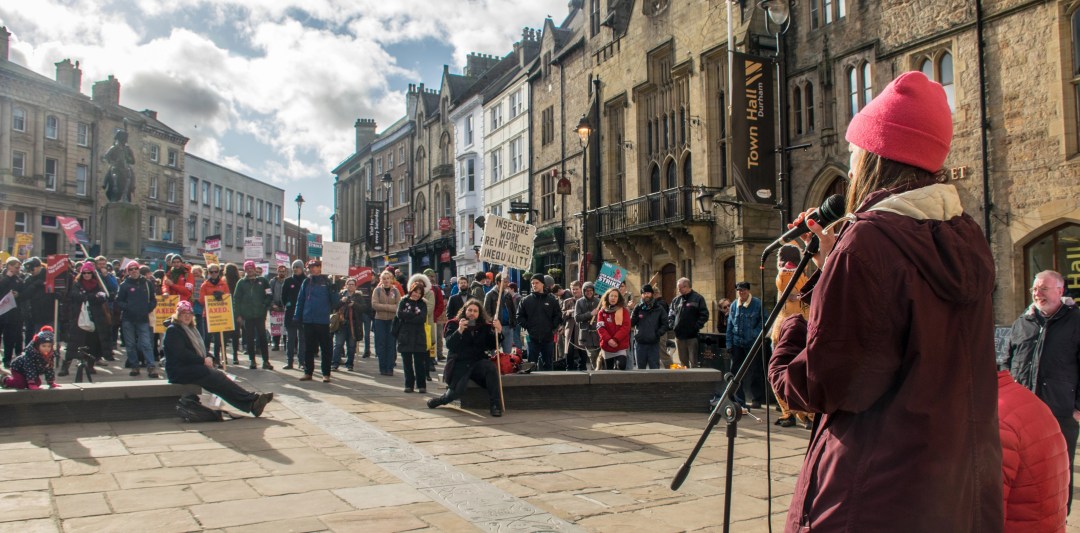
I am originally from a seaside town in Somerset, and have spent my whole adult life in the North of England since moving to Durham for university. Politics was not a typical tea-time discussion in my family but my Mum taught me about feminism from when I was small because she was determined I would not experience the same barriers she did. My earliest memory of taking collective action is when I was five, holding my Mum’s hand and a small placard at a demonstration she organised to petition my infant school’s management over failures to keep us safe at breaktime.
Now I work in widening participation at the University of Leeds, where I am our UCU branch’s Honorary Secretary, a caseworker, and a former branch President. I have served UCU in roles from casualised rep to UCU UK President since 2009.
At an incredibly difficult time UCU gave me a sense of dignity and confidence in our collective power and support, care, and empathy for each other. Getting involved was a lifeline for me because organising alongside others countered the isolation I felt as a casualised postgraduate trying to get by. The Covid-19 pandemic and dealing with long covid brought this home to me again.
Thanks to successful local campaigning, I now hold a permanent academic-related/professional services contract. Before that, I was insecurely employed in academic and academic-related posts for over a decade, stitching together a patchwork of multiple precarious part-time and hourly-paid incomes. I spoke out about the toll these experiences take on precarious members in an interview with the Guardian in 2013 while working in Durham and Leeds, relying on friends for beds and sofas away from home.
Organising at every level of UCU has shaped my own political education and has taught me about how we work together, and what we need to move forward. I have lived the daily challenges faced by branch officers and activists and understand the complexities of representing members while negotiating with management at local and UK level. Knowing first-hand the impact precarious employment has on lives and livelihoods and how organising with others can be a lifeline fuels my commitment to our union.
Why I am running for General Secretary
I believe in our union. Recent wins across Further and Higher Education do remind us what we are capable of. But I believe that we need an urgent change of approach. Disappointing results in the latest aggregated ballot on pay and conditions in Higher Education and mixed results in the latest rounds of balloting in Further Education have left many members disenchanted and dissatisfied with the distance between the rhetoric used during campaigning and what actually happened.
When we obtain reduced turnouts or even miss a ballot threshold at branch or aggregated level, we need to ask serious and thoughtful questions, and spend time listening to members and activists who have been doing the sensitive work of getting the vote out on the ground.
I know that significant culture change is possible in our union. I wrote about this recently when reflecting on how far we have come in the development of our campaigning and bargaining against casualisation. A heartfelt rain-soaked conversation as a postgraduate in early 2009 got me involved in local, and then UK-level anti-casualisation work. On becoming Chair of the Anti-Casualisation Committee I was determined to work with everybody in whom we could encourage interest in how casualisation affects us all. I learned a lot about listening and navigating disagreement in the process. Developing networks of casualised members and permanently employed allies meant that over several years, through democratic means and working across apparent political divides within the union, we secured better cross-sectoral representation of casualised staff at local, regional, and national level. This is also how we secured the inclusion of anti-casualisation objectives (backed by robust data collection) in local and national bargaining claims. In other words, we transformed our bargaining agenda through dogged pursuit of dialogue where there had been division on this issue.
Good leadership means drawing on the strengths of all our members across all sectors and all nations. We need to better navigate divisions and differences of opinion in UCU and recognise that failure to do so has contributed to a withdrawal of many members from active participation. I have chaired innumerable difficult meetings involving significant disagreement, including in time sensitive and high stakes sector-level negotiations and associated preparatory UCU meetings. We need leadership to move us beyond the domination of factional politics, and to place members front and centre of everything we do.
We also need leadership that recognises a wealth of educational establishments where members have historically felt sidelined by concerns in Higher Education. As General Secretary I will commit to regular and meaningful engagement with members across post-16 education. I will support and resource greater development of regional and national networks to encourage engagement and reciprocal learning through members sharing experiences and advice across our sectors.
As Vice President (2019-20) I chaired the Higher Education Committee (HEC) and two UK level negotiation teams (for pay and conditions – 4 Fights, and the USS Superannuation Working Group). During this time, we made headway on USS by establishing key forums to interrogate the disputed valuation methodology underpinning the dispute. In negotiations with UCEA we broke new ground, including bringing our demands on pay related conditions into formal talks rather than non-binding working groups for the first time. While our industrial action and careful negotiation shifted the terrain, we clearly have some way to go in tackling these issues. Our negotiations with employer bodies across the post-16 education sector must focus on concrete plans to tackle pay erosion, inequality, precarity and dangerous workloads exacerbated by difficulties over recruitment and retention when conditions are known to be so poor. To maximise our leverage in every dispute we need to forge paths through disagreement rather than continuing to allow division to be a defining characteristic of UCU politics.
As President (2020-22) I chaired the National Executive Committee (NEC) and three meetings of UCU Congress (online owing to pandemic restrictions). The challenge of holding together elected negotiation teams, navigating differences of opinion between negotiators, and handling debate in chairing meetings reinforces my belief that limiting debate is not the way to resolve deeply held disagreements or to strengthen collective responsibility.
How differences of opinion and public debate about disagreement in UCU unfold speaks to issues we must tackle in our union’s democratic culture. Some problems arise or are exacerbated by time pressures combined with how our formal meetings are framed around recommendations or motions that can result in polarised positions. This polarisation is sometimes further exacerbated by the late receipt of industrial and/or legal advice. Recent moves to broaden consultation have resulted in impenetrable or unnecessarily limited or binary choices being put to the vote in e-surveys or e-ballots at short notice, often leaving members and reps feeling frustrated. As General Secretary, I will work with lay democratic structures to foster constructive, deliberative discussion and opportunities to hear out differing perspectives in a timely fashion. I will prioritise equipping the members and committees making decisions with reliable information and urgent support to explore conflicting ideas when needed, out of respect for our union’s democratic structures.
Changing our culture will take effort and time. We cannot wish away political divides in our union, nor should we seek to erase multiple perspectives. As a union founded on principles of democracy and equality, I believe that disagreements can be a source of creative strength, if handled well by affording them time, space, and ensuring that discussion is informed by timely legal and industrial advice.
- Sign up for email updates (including about the manifesto)
- If you are able to contribute to campaign fundraising please go to the Go Fund Me page.
 Vicky Blake